
Rupture Without A Reason
The ending was completely on Spencer’s terms, and there was nothing Dean could do about it. After nine years together, Spencer and Dean had grown and built a life together. They had a strong foundation, shared values, and sexual compatibility. So Dean moved to Seattle from LA, they bought a townhouse together, got engaged, and integrated their lives; there was no visible fracture, which is exactly why the abrupt ending felt incomprehensible.
When I began my conversation with Dean about this 2016 breakup that took him nearly nine years to heal from, I was skeptical. I had questions about why the healing had taken so long. But when he described his breakup, I realized that this was a true rupture event that no one would have taken lightly. A rupture consists of a total lack of narrative, participation, or shared meaning-making. It’s a blindsiding event, and that’s what destroyed Dean.
In the course of our conversation, Dean could not name what actually “caused” the breakup. Spencer and Dean only lived together for about a year after being long-distance and then having separate living spaces in the same city. Perhaps the relationship had worked in a distanced form, but didn’t work for Spencer when they lived together. But that’s all speculative: I didn’t interview Spencer, and Dean didn’t have a clear answer in 2016 or 2026.
What Dean did share was that when Spencer told him that he was “done,” Dean responded by saying “we’re done with what?” Dean explained that the pseudo-conversation that initiated the breakup felt like a sucker punch.
“There was no conversation… no ‘we need to try things differently.’ To this day, he has never been able to say why he ended the relationship. […] It doesn’t add up… how could you ask me to marry you… and then say you don’t love me?”
This was a blindsiding breakup. This was a rupture.
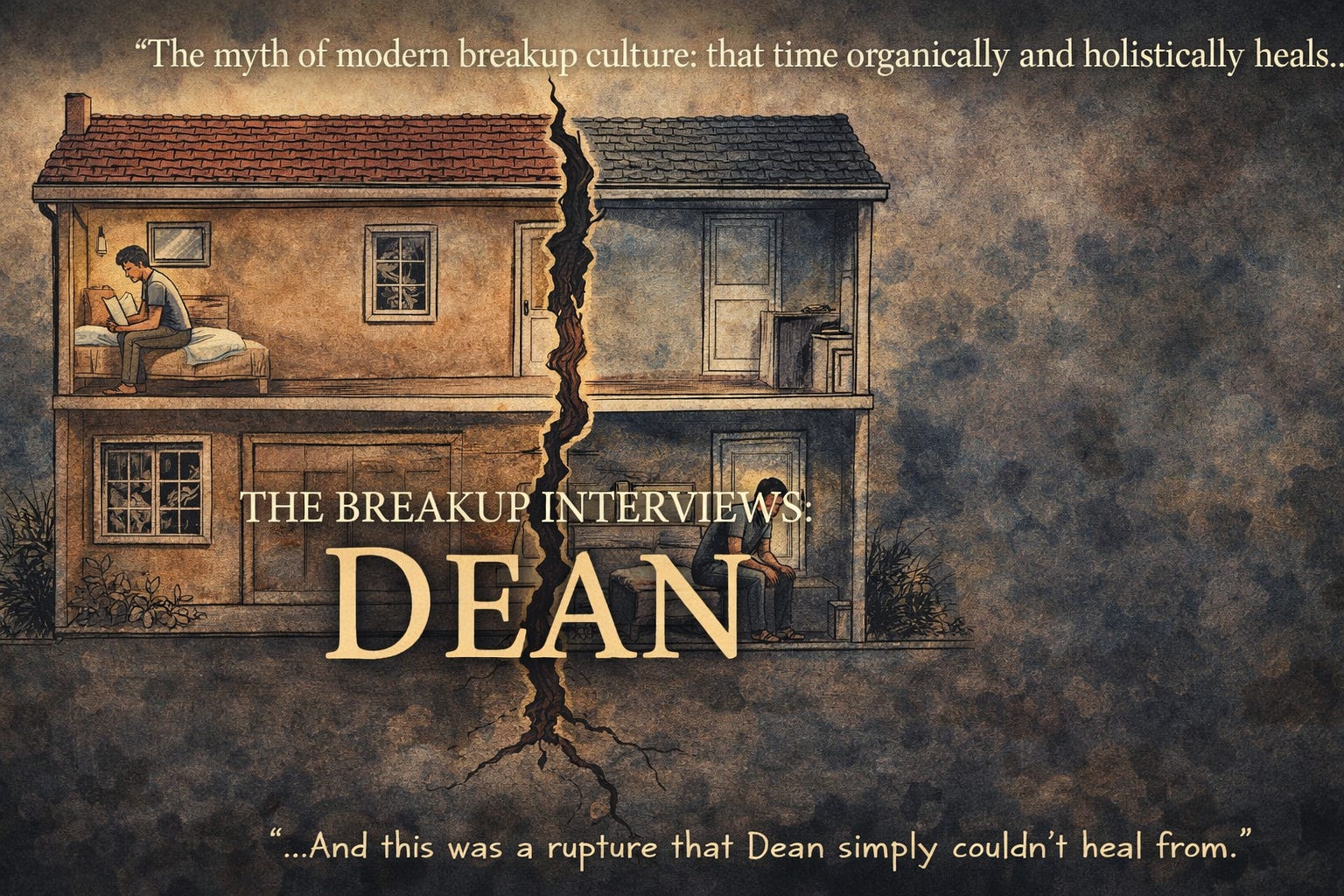
And this was a rupture that Dean just couldn’t heal from. But why? At a certain point, wouldn’t he simply accept the reality and “move on”? This is the myth of modern breakup culture: that time heals organically and holistically.
In Dean’s case, instead of the rupture turning into an accepted ending and subsequent separation and detachment, the rupture never evolved into a marked ending and, instead, turned into prolonged exposure and consistently re-ruptured grief. This is his story.
The Trauma of Cohabitating
“After the breakup, we coexisted for over a year. We had very little contact. We were really just passing each other and not saying a word.”
When a rupture occurs in a relationship, it’s reasonable, and perhaps adaptive, to run away from the rupture site. Dean and Spencer had just bought a townhouse together that they equally owned and, without explicit conflict or disdain, Dean’s confusion and pain did not urge him to run away from his home with Spencer.
The rupture became environmentalized through their continued cohabitation. The physical layout of the townhouse was a significant detail in characterizing the environment of their cohabitation: Dean moved downstairs to the guest suite, while Spencer stayed upstairs in what had been their shared bedroom. But even with this proximity, they barely uttered a word to one another during this year. Time and silence did not heal anything.
As Dean shared more with me, I realized that this period of cohabitation was a year of chronic traumatic exposure and re-exposure: exposure to Spencer, exposure to the seemingly unfounded breakup, exposure to the seemingly senseless silence. It was a year when the rupture turned into avoidance and prolonged suffering.
And, with malice or not, Spencer was rubbing salt in the wound:
“[Spencer] started inviting guys over [for sex]. That was hurtful. That was really painful. [The pain] was a sort of a grief on top of a grief. And the hurt turned into hate.”
Dean painfully shared what it was like to overhear his previous lover and life partner talk, laugh, and engage with new men intimately. After watching Spencer walk one of his lovers out of the townhouse and kiss him goodbye in front of his window, Dean demanded an end to the cruelty. But by that point, the proximity and repeated exposure had reinforced anger as his survival strategy. Dean explained that “hurt turned into hate” and thought “that was kind of how I had to survive.”
Dean had no closure and certainly had no ritual to lean into. He didn’t even have the language or inspiration to consider it. He felt completely trapped in his grief, trapped in his anger, trapped in his resentment, trapped in his sadness.
A Twisted Attempt at Ritual
“I asked him if we could go see a counselor together. I’ll admit, I did still want to save the relationship, or, if we couldn’t, I wanted to understand what happened.”
When Dean told me that, a year after the breakup, he finally asked Spencer to go to couples therapy, I felt my heart rate slow slightly. Finally, the hope for some kind of ritual for closure and understanding. Finally, a chance for them to separate with some semblance of a container. But this soft attempt at ritual was totally violated and perverted. It was ultimately more wounding because it was, in essence, an anti-ritual.
When Spencer agreed to do couples therapy, it was on the terms that he pick the couples therapist himself. Regardless of who picks a therapist, couples therapy has the potential to be a space for understanding, shared narrative creation, and closure. It can be a container with a beginning, middle, and end to co-create healing. That is precisely my definition of ritual.
But couples therapy needs a psychologically safe therapeutic alliance for both parties in order for such a container to exist. That is not what Dean experienced. There was a caustic and unbalanced energy when he walked into the room. There was little room for him to ask questions, explore, share, or emote.
“[Spencer and the therapist] just basically machine-gunned me, it was like they had this therapy session worked out in advance.”
And the only explanation or clarity Dean was offered from Spencer was the crippling refrain: “I don’t love you anymore.”
Dean’s pained attempt for clarity and answers had been shot down, point blank. And I wish I could say that that’s where the ritual failed. But it didn’t just fail, it was perverted. In the most shocking and disturbingly unethical revelation, Dean went on to learn that this therapist Spencer had chosen had been one of Spencer’s sexual partners. There was no opportunity for a safe container because Dean unknowingly stepped into a dual relationship that made it impossible to have a protective experience of healing or a corrective emotional experience under any circumstances.
Dean left this experience defeated. The messaging was clear: there is no explanation, no fairness, and no safe place to process. This belief is how grief and unresolved attachment can linger for years.
Prolonged, Unresolved Grief
“I did not want to take another chance.”
Even after Dean had moved out of the house and begun to separate from the trauma of his attempt for closure through couples therapy, his repeatedly re-ruptured breakup wound had become a chronic injury: infected, sensitive to the touch, oozing, and seemingly unable to ever heal.
And the painful persistence of that wound made it impossible to ignore. It became Dean’s fixation and obsession on the basis of pain, not on the basis of longing. That’s not to say there wasn’t longing. One of the most painful points for Dean was that the love he felt for Spencer never diminished, even after so much anger and pain. He shared that his philosophy on love got stronger: “if I once told you I loved you, I still do.” And while holding onto that belief reinforced the pain, it felt like the only option he had.
What Dean described was attachment grief without resolution. Of course, it was inconceivable that he seek out another relationship, whether because of his persistent and undying love for Spencer or because of his depressive mistrust and rage born of the unresolved rupture. Time moves differently when your heart and nervous system are in such a state of total and holistic shock, so months led to years. And Dean truly thought he would be in this cycle of grief, rage, numbness, and pain forever.
There was no psychological completion. There was no hope for a container. And time certainly did not lead to transformation.
An Embodied Ritual
“I just melted. We stood together and held each other for like ten minutes.”
My research is about the power of stepping into ritual and how choosing ritual during grief can heal you in completely unimaginable ways. Dean didn’t step into ritual, but ritual found him anyway.
Five or six years after the failed ritual attempt of couples therapy, Dean stumbled into ritual in an unexpected way. It’s not uncommon to seek out a massage therapist who does sensual or erotic touch as part of their work. It’s especially common to reach out for such a service when your body has been in such a state of withdrawal from any form of intimate touch.
When Dean first booked an appointment with Christian, he wasn’t seeking a body-based experience to reopen connection. If anything, he was terrified stepping into a physical experience that required nakedness and vulnerability. But Christian knew how to create meaningful, intimate containers even in the practice of erotic massage.
His first appointment with Christian was not intended to be a ritual or a container, but Dean’s body was in such a state of withdrawal that Christian seemed to be able to immediately tell that Dean needed something spiritually healing: not just physical or erotic release.
In the first ten minutes, Christian just embraced Dean, sensing his anxiety, grief, and pain. Dean explained:
“…to just hug another human being… It was one of the most incredible experiences. […] I just melted. I didn’t realize there were tears running down my face.”
A ritual is an intentional, repeated act that gives form to an ending. It has a beginning, middle, and end and serves as a container to make meaning or connect with something bigger than yourself. Perhaps Dean didn’t step into this ritual with the intention of it being a ritual. But as he shared with me, the intention was oozing out of him based on the severe level of grief living in his body, grief that had remained unmarked and unprocessed.
Dean returned to Christian many times, developing a partially transactional, partially intimate relationship with him. He did not see him as a romantic partner or boyfriend, he saw him as a physical and spiritual source of healing. The collaborative rituals with Christian, which did eventually include sexual contact, provided touch, attunement, and aftercare. And the more he stepped into that ritual, it reinforced his worth, desirability, and capacity to love.
Perhaps it’s shocking or taboo to talk about something so physically intimate as a ritual, but sex is certainly a form of ritual in relationships. This isn’t to say that every time you have sex, you are participating in a ritual. But I know that many of you reading have stepped into erotic experiences as a form of container, with a higher purpose, with shared meaning with a partner. And that is where sex can exist as ritual.
That’s what Dean found, or what found Dean. And perhaps waiting for ritual to find you is what people mean when they say “time heals.” But if Dean’s story teaches anything, it’s that waiting for healing or waiting for ritual can prolong pain. And you can’t know how long you’ll wait for that relief.
I asked Dean whether he believed he could have created some kind of intentional ritual to help himself heal sooner, or if he felt that he had to wait for something like that to find him over time.
He didn’t reject the idea that ritual could have helped him sooner, but he made it clear he wasn’t in a place where he could access it. As he put it, “I just was like, nope, nope… I cut it off… I do not want to take another chance,” describing how shut down and protective he became for years after the breakup. In other words, it wasn’t that ritual wasn’t available, it’s that he wasn’t yet resourced enough to step into it.
A Reencounter and Conclusion
Years later, without planning or intention, Dean found himself face-to-face with Spencer again at a holiday event. It was shocking, but in a matter of minutes, something shifted. “It just… all of a sudden wasn’t there anymore,” Dean told me. “The hate… the grief… everything… was just gone.” The anger that had sustained him for years dissolved in real time, replaced by something softer. So much had changed within Dean without him fully realizing it. After nearly a decade of unresolved grief, something reorganized: not because he got answers or a clear “why,” but because his nervous system had finally registered an ending. “This is a better place to end,” he said. Even without conscious intention, ritual had found him and given his grief a place to settle.
Dean’s healing wasn’t dependent on Spencer, but it also wasn’t absent of ritual. In the years between the rupture and that final encounter, he had already begun participating in ritual, just without naming it. Through repeated, embodied experiences of physically safe intimacy, he stepped into a kind of container that slowly reconnected him to himself. He rediscovered something the breakup had nearly taken from him: his ability to love. “Loving somebody… regardless of the conditions… is really powerful,” he told me. “Even if that person doesn’t feel the same way.” And with that love being divorced from grief and rage, Dean could now experience love with acceptance and helpful detachment. That’s what ritual gave him.
Dean’s path to healing through ritual was indirect. He found ritual eventually, but only after suffering without it for years. And because of that, in the absence of ritual, grief lingered. This is not a failure of Dean. It’s a reflection of something broader: we do not associate endings with grief, and we do not associate grief with the need for containers. Healing becomes something we wait for, rather than something we step into.
And yet, there is something deeply hopeful in where Dean arrives. He didn’t need perfect closure, and he didn’t need a new relationship to overwrite the old one. By the time he stood across from Spencer again, something had already shifted within him; the ritual that came late simply allowed what had been building to finally settle. “I don’t feel like I need to jump into another relationship,” he said. “I have my life… It’s not missing anything.” Dean’s story is not one of permanent damage, but of prolonged healing, and a quiet caution: not that we won’t heal, but that without intentional ritual, without containers to hold our endings, our grief can linger far longer than it has to.
When I read this, it makes me so sad. I’ve been through a hard time with my breakup. It was like I didn’t see it coming. One conversation about the progress and where we were at just pushed him away the next day he saw me.
I was shocked and panic. It’s been 3 months and the grief hits me so hard.
Thanks for sharing this