
It’s easy to recognize that a breakup is an ending. It’s harder to recognize that a breakup is not a failure.
But the radical notion that I am asserting is that a breakup initiates a new phase, a new stage. Not a stage of continued commitment, but a stage of potential redefinition. A breakup is a stage to redefine the relationship’s meaning, one that requires intentional engagement to move through.
Conventional culture treats the end of a relationship as something innately destabilizing, something to recover from and “move on” from as quickly as possible.
But this framing misunderstands the nature of relationships entirely. A relationship is not defined solely by its continuation, especially when there are countless reasons and ways for a relationship to end. To make a breakup synonymous with severance is to suggest that the relationship itself must be minimized in order to survive the ending.

What I have observed is that conventional breakup culture seeks to deny the meaning of a relationship as an antidote for the pain of the breakup itself. When we accept that breakups are a natural phase in the lifecycle of a relationship—even when they are laden with pain—we can begin to engage with them deliberately rather than running from them.
This is a radical idea, but it does not deny the disorienting nature of a breakup. A breakup is, indeed, a “break”: a fracture, a rupture, a schism. This is not a metaphor: neuroscientist Mary-Frances O’Connor of the University of Arizona found that bereavement and romantic loss produce the same qualitative experience of yearning.
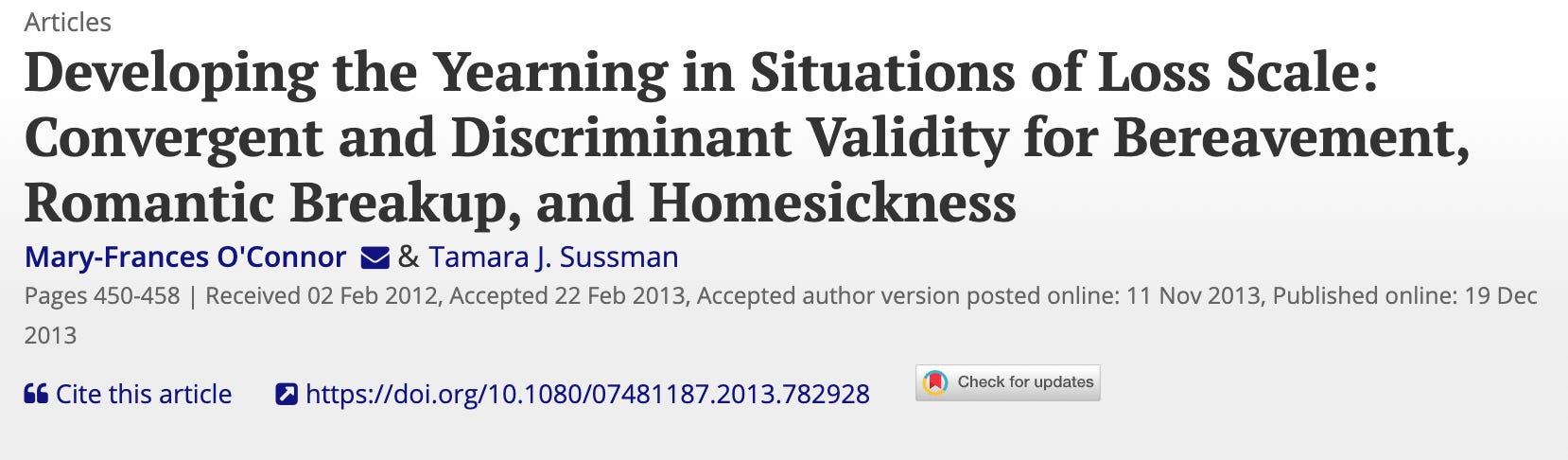
If we choose to frame breakups as experiences of attachment grief, we can honor the gut-wrenching yearning and loss so many experience in the body. The contemporary language around breakups denies this psychosomatic reality, and with it, the possibility that a breakup initiates a stage that demands intentional engagement to move through.
The culture of breakup severance is wildly misaligned with what the body is going through during a breakup. When two people form a deep bond, their nervous systems become intertwined in a process called co-regulation: each person’s nervous system learns to stabilize through contact with the other.
When that bond is severed, the nervous system doesn’t immediately adjust; it experiences something closer to withdrawal. Oxytocin, dopamine, and other neurochemical systems that were calibrated around the presence of another person are suddenly without their object.
This is not weakness or over-sensitivity; it’s literally how attachment works. The attachment system, built to protect bonds, remains active long after the relationship has ended, still sending signals and receiving no response.
If you have experienced the death of a close loved one, maybe this sounds familiar. That’s because understanding breakup pain as attachment grief is crucial, and it fundamentally changes how we relate to the experience.
When we think about breakups through the lens of grief, we also have to examine what exactly we are grieving. The grief of a breakup operates on two distinct levels, and both deserve to be named. Just as in death grief, the second level is often the more consuming one:
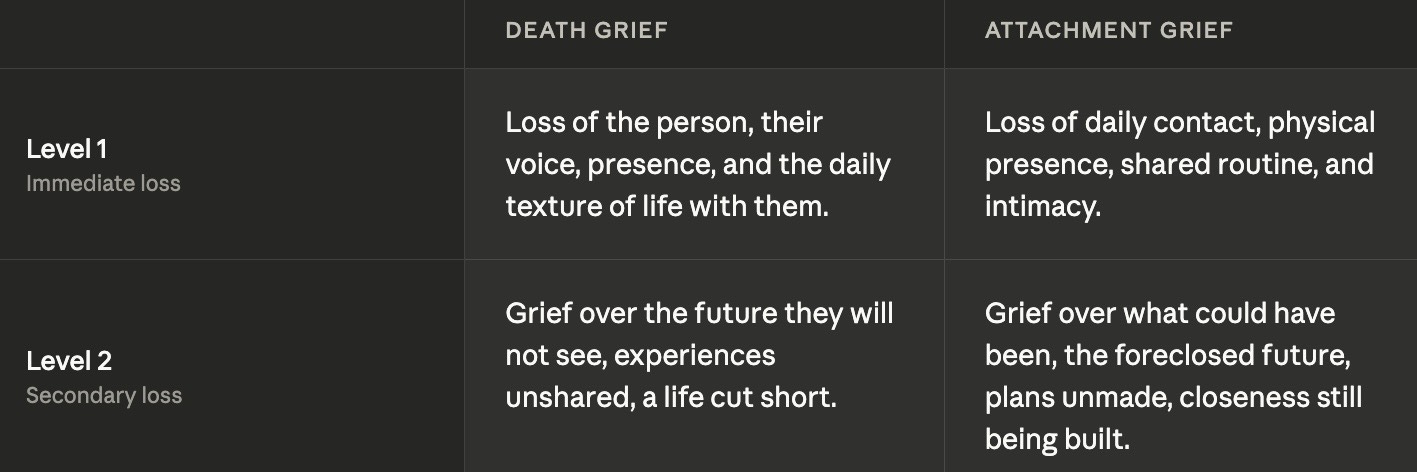
Without a grief framework and armed only with flimsy tools to process a breakup, we are often left wandering. And therein lies the core structural problem with how we handle breakups: the absence of ritual.
Death has always been accompanied by formalized grieving structures: funerals, mourning periods, communal meals, and symbolic gestures. Because human beings have long understood, intuitively, that uncontained grief has nowhere to go, it just accumulates. These death-related structures are not perfect, but their universality suggests something important: human beings have always known that grief requires a container.
Breakups receive no such infrastructure. Attachment grief lacks ritual in the way we have it for death grief, and needs it just as much.
A ritual is an intentional, structured engagement with an emotional reality. It has a beginning, a middle, and an end. It employs symbolism. It is a container within which grief can be held and moved through rather than avoided or suppressed.
Without that container, people are left to improvise. They distract, they ruminate, they reach back toward the person they lost, they numb. These are coping mechanisms at best, and while coping mechanisms have their place, they are not rituals. It is remarkably rare for someone to bring genuine ritual to a breakup.
The distinction is intention. Distraction is accidental; ritual is deliberate. Coping mechanisms manage the pain: they reduce it, postpone it, make it livable. But without the deliberate, structured, and symbolic engagement that ritual provides, grief has nowhere to go. It, once again, accumulates.
A breakup does not need a promise that the pain will disappear—and that is not what ritual is promising. Ritual promises to provide intention, structure, and that the pain will have a place to go. When we see a breakup as a stage rather than a severance, and as attachment grief rather than a personal failing, we create the conditions for something ritual alone can provide: an opportunity to metabolize loss.
A breakup, moved through with intention, can become more than a wound to recover from. It can become a passage: one that honors what was real, integrates what was lost, and makes room for what comes next. This is not optimism. It is structure.
For the heartbroken, the intentional, symbolic, and deliberate structure of ritual is what we have been missing. And the cruel irony is that it runs counter to every instinct conventional breakup culture offers. But it is what the body is begging for.
This is a nice sum up of your thinking Ben. I appreciate it now - especially as I'm beginning to feel as though I am moving in to the next chapter of my life - in order to move forward with the break up I've needed to really be truthful with myself as to what the relationship meant, in the light of the fact that it ended as it did. I've needed to understand what that chapter meant in the arc of my life's narrative.
It's like I have to weave the ending into the time we were together, and see him in a different light - without minimising the wonderful times. It's intentional work, and is taking time.
I feel as though I have become much more purposeful with my life post-break up - it's a very conscious question - "How do I want to live now?". Possibly accompanied by that other question "Who am I?". And honouring these questions make my whole current life feel like a ritual.
And in ritualising things that I do now I am saying goodbye to the relationship each time.